Skip to content

Department of Anthropology

A Brief History

Anthropology is the comparative, evolutionary and historical study of human and non-human primates. Our internationally respected faculty takes a theoretically-driven, empirically-informed approach to the discipline. Our core mission is to discover and communicate new knowledge
through basic and strategic research, the foundation from which we educate and train scientifically literate and intellectually engaged citizens and equip them with relevant skills for the modern world.

The University of Utah has a long history of anthropological and archaeological research. Henry Montgomery, professor of natural history, began academic archaeological research at the University in the 1890s. In 1914, Byron Cummings founded the Department of Archaeology. In
1917, a joint Department of Anthropology and Sociology was created, and in 1926 Anthropology became a separate department, though briefly reunited with Sociology from 1933 through 1948. The Department grew significantly during the 1960s and 70s and enrollments increased. At that
time, the faculty approached its present size (15 FTE) and a PhD program was added to the curriculum. A shift to an evolutionary and empirical focus emerged in the mid-1980s. This continues today: the department is recognized for its unified scientific and evolutionary approach to major
questions in the discipline and cognate fields, including biology, environmental science, geology, and human genetics.


Upcoming Events

April Colloquium

image of Peter Turchin Flyer for Anthropology Colloquium April 2, 2026

Thursday, April 2nd
2:15 pm
MLIB 1170
Click here to RSVP for Zoom link

The Great Holocene Transformation: Cultural Macroevolution of Social Scale and Complexity

During the Holocene the scale and complexity of human societies increased dramatically. Generations of scholars have proposed different theories explaining this evolution, which range from functionalist explanations, focusing on the provision of public goods, to conflict theories, emphasizing the role of internal class struggle or external warfare. I use a general dynamical model, based on the theoretical framework of cultural macroevolution (CME), and data in Seshat: Global History Databank to quantitatively test these theories. The best-supported model indicates a strong causal role played by a combination of increasing agricultural productivity and intensity of interpolity warfare, proxied by invention/adoption of military technologies. Overall, these empirical results provide support for two major theoretical ideas in CME: cumulative cultural evolution and (still controversial) cultural multi-level selection.


Student Success Resourses

OUR COMMITMENT  

Support Students Today

Donations help support scholarships and fellowships for deserving anthropology students and make possible guest lectures by leaders in the field.

MAKE A DIFFERENCE

Prefer to give by phone?

Call us at 801-587-9310

For personal assistance with giving options, please contact giving@csbs.utah.edu


Undergraduate Programs
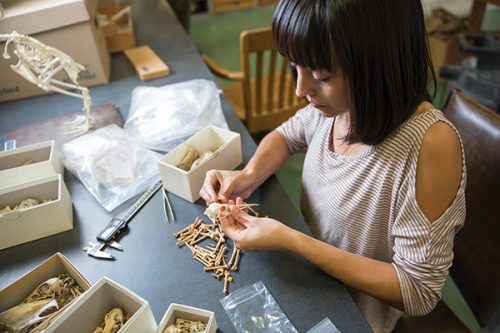

Image of a female student organizing lots of different small bones on a desk. Many tools around her as she sits in a brown chair.

Anthropology Major

Anthropology is the comparative, evolutionary and historical study of human, and nonhuman primates. 

 EXPLORE MAJORS AND EMPHASES 

Anthropology Minor

Because we study all aspects of humans, anthropology is holistic and inter-disciplinary and anthropologists work hand-in-hand with other sciences such as biology, physiology, sociology and psychology—just to name a few.


Integrative Human Biology Minor (IHB)

Engage in research in human form and function, human evolution and biological variation, human behavior, and the roles humans play in local and global ecosystems. Students will acquire the broad but rigorous background they will need as professionals in the 21st-century health sciences and many other fields that engage directly with aspects of human adaptation and welfare.

EXPLORE ANTHROPOLOGY MINORS 


Have a question about anthropology? Ready to declare?

BOOK AN ADVISING APPOINTMENT 


Last Updated: 3/6/26